Why Does Richard Serra Make the Art He Do

Richard Serra commands fourth dimension and space seamlessly through steel sculpture. From his native San Francisco cityscape to remote areas in New Zealand, the artist has populated picturesque panoramas worldwide with his formidable installations. His stiff personality continues to pique comparable curiosity.
Richard Serra's Early Life

Richard Serra grew up a gratis spirit in San Francisco during the 1930s. Frolicking among the sand dunes in his own backyard, he had fiddling exposure to fine arts early in life. He spent time with his working-class immigrant father, a pipage-fitter at a local Marine Shipyard. Serra recalls ane of his start memories on-base of operations witnessing an oil tanker launch, where he became instantly spellbound by his sizable surround. At that place, he gazed longingly at the ship'due south hull, admiring its robust curve while information technology whizzed in the water. "All the raw textile I needed is contained in the reserve of this retentiveness," Serra claimed in his old age. This adventure ultimately boosted his self-confidence enough to begin drawing, experimenting with his fierce imagination. Afterward in life, he'd revisit these fascinations through obvious allusions to his days alongside his begetter at the Marine Shipyard in San Francisco.
Where He Trained

California similarly served as abode-base throughout his early on grooming in the late 1950s. Serra pursued an English language degree from UC Berkeley earlier transferring to its Santa Barbara campus, where he graduated in 1961. His interest in art particularly heightened while attending Santa Barbara, given his studies under famous sculptors Howard Warshaw and Rico Lebrun. Subsequently, he obtained his G.F.A. from Yale, during which he met contemporaries Chuck Shut, Brice Marden, and Nancy Graves. (He notably considered them all much "more than avant-garde" than himself.) At Yale, Serra also took great inspiration from his teachers, mainly the world-renowned abstruse painter Josef Albers. In 1963, Albers stimulated Serra's inventiveness past requesting he peer-review his Interaction Of Colour, a book nigh teaching color theory. Meanwhile, he likewise worked tiresomely in steel mills to support himself during his unabridged educational tenure. This unique occupation would set the foundation for Serra's prosperous sculptural career.
Are you enjoying this commodity?
Sign up to our Costless Weekly Newsletter
Please check your inbox to activate your subscription
Thank you!
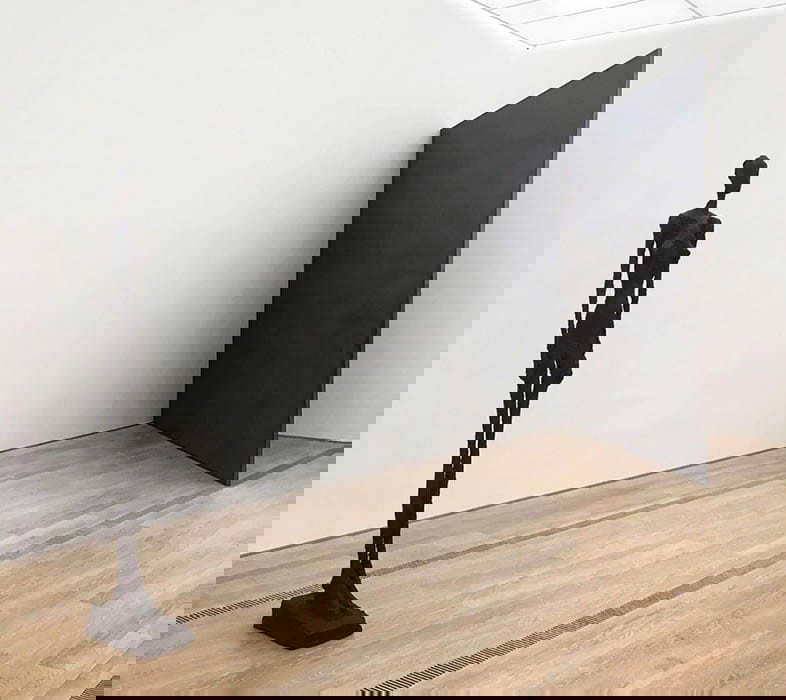
In 1964, Serra secured a Yale Travelling Fellowship to study abroad in Paris for one year. Past keeping in touch with his classmates from home, he also encountered an easy introduction to the city's contemporary sphere. His future wife Nancy Graves had introduced him to composer Phil Glass, who spent fourth dimension with conductor Nadia Boulanger. Together, the group frequented Paris'southward legendary intellectual watering pigsty, La Coupole , where Serra first met Swiss sculptor Alberto Giacometti. He before long discovered an fifty-fifty worthier source of influence. At the National Museum of Modern Art, Serra spent hours sketching crude ideas inside late sculptor Constantin Brancusi'due south reconstructed studio. He also took prolific life drawing classes at Académie de la Grande Chaumière , however, few relics prevail from this time period. Surrounded past new media, the artist awakened creatively in Paris, learning firsthand how elegantly a sculpture tin dictate physical space.
His First Failed Solo-Show

A Fulbright Scholarship took Richard Serra to Florence in 1965. In Italian republic, he vowed to completely abandon painting, instead turning his attention toward sculpting full-time. Serra traces his verbal transformation to when he visited Espana, stumbling upon Gilt Age master Diego Velazquez and his iconic Las Meninas . From then on, he resolved to avoid complex symbolism, concerned with materiality, and less so with two-dimensional illusions. His subsequent creations referred to as "assemblages," comprised wood, live animals, and taxidermy, juxtaposed to elicit farthermost emotional reactions. And Serra did precisely that when he exhibited these caged provocations during his first-always solo-show at Rome gallery La Salita in 1966. Not only did Time pen a scathing review on the horrid debacle, but public outrage from local Italian artists also proved as well much for Rome to bear. Local police shut down La Salita quicker than Richard Serra caused his highly publicized commotion.
When He Moved Dorsum To The U.Southward.
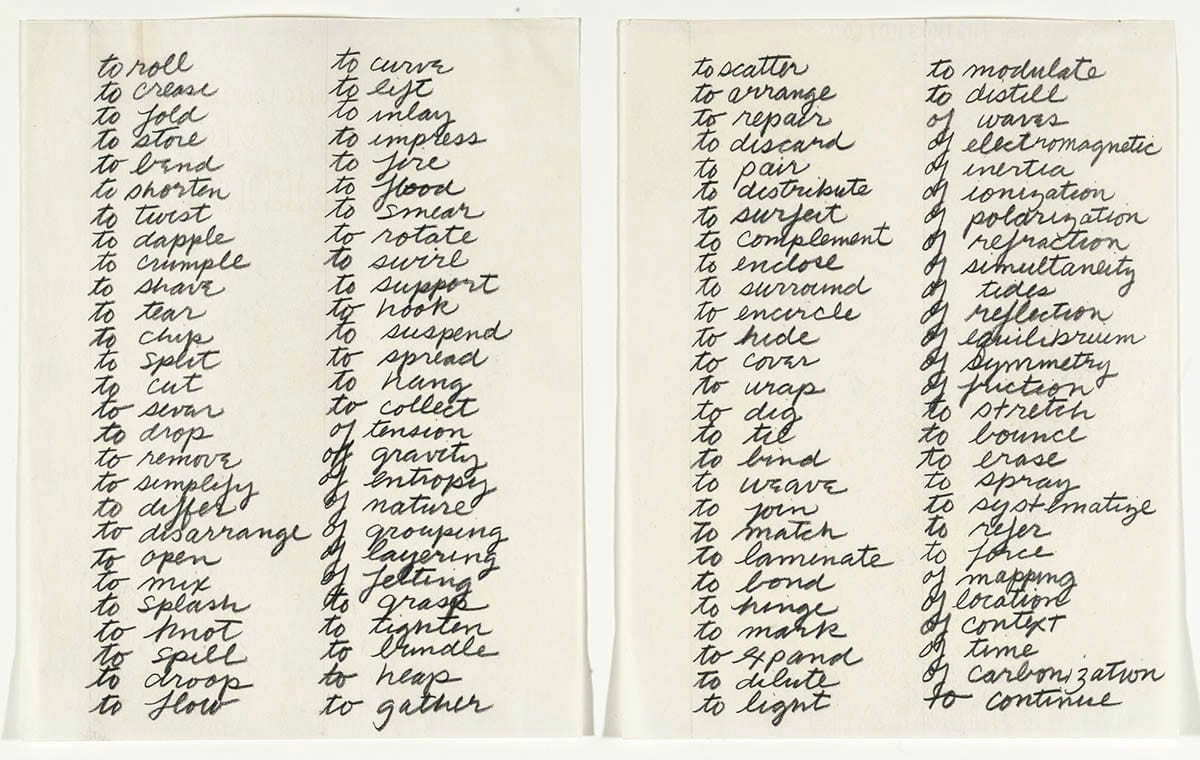
New York met Richard Serra with more enthusiasm later on that year. Settling in Manhattan, he quickly warmed up to the city's avant-garde scene, then dominated by Minimalists who legitimized sculpture as inherently valuable, regardless of its power to clear ane's inner woes. In fact, precursor Robert Morris even invited Serra to participate in a Minimalist group evidence at The Leo Castelli Gallery ; and he propped his work alongside influential voices like Donald Judd and Dan Flavin. What the artist lacked in commensurate glitz he made up for in swashbuckling grit, however. Every bit Serra said himself, his work fundamentally differed from his peers because he wanted to "become downwardly and muddy." To stand up out from the crowd, he subsequently coined a now-legendary litany of intransitive verbs titled Verblist , scrawled with manual actions similar "to split," "to curl," and "to claw." This Process Fine art forerunner would besides serve as a simple blueprint for Serra'due south lucrative career to come.
First 1960s Sculptures

To test his experimental philosophy, Serra turned to eclectic materials similar pb, fiberglass, and rubber. His multimedia milieu had also profoundly affected his view of sculpture, particularly its propensity to push button viewers beyond a painting's visual confines. Between 1968 and 1970, Serra created a new sculpture series, Splash , by pouring molten lead over a corner where his wall and floor collided. Eventually, his "gutters" caught casting devotee Jasper Johns's attention, who and so asked him to recreate his series at John's Houston Street studio. That aforementioned yr, Serra likewise unveiled his famous I Ton Prop , a four-plated pb and alloy structure stacked to resemble an unstable house of cards. "Even though information technology seemed information technology might collapse, information technology was in fact freestanding. You could see through it, look into it, walk around it," Richard Serra commented on his intended geometric production. "At that place'south no getting effectually it. This is a sculpture."
1970s Site-Specific Shift

Richard Serra reached maturity during the 1970s. His first methodological deviation traces back to when he assisted Robert Smithsonian with Spiral Jetty (1970), a swirl constructed from six g tons of black rocks. Moving frontwards, Serra contemplated sculpture as related to site-specificity, pondering how physical space intersects with medium and motion. Provoking a sense of gravity, vitality, and mass, his 1972 sculpture Shift best demonstrates this deviation toward big-scale, outdoor works. All the same nigh of these early archetypes weren't created within the U.S. In Canada, Serra installed 6 concrete slabs throughout fine art collector Roger Davidson'south farm to accentuate its rugged landscape's contours and zigzags. Then, in 1973, he installed his asymmetric sculpture Spin Out at the Kroller-Muller Museum in holland. The steel-plate-trio forced passersby to pause, reflect, and relocate in social club to perceive information technology correctly. From Germany to Pittsburgh, Richard Serra rounded his decade enjoying considerable success around the world.
Why Richard Serra Caused Controversy

Simply controversy beset him in the 1980s. Later enjoying a positive reception across the U.South., Serra stirred an uproar in his Manhattan stomping grounds in 1981. Deputed as part of a U.S. General Services "Art-in-Architecture" initiative, he installed a 12-human foot-tall, fifteen-ton, steel sculpture, Tilted Arc , dissecting New York's Federal Plaza into two alternate halves. Rather than focus on optical altitude, Serra sought to completely alter how pedestrians navigated the plaza, forcibly eliminating inertia to impel activity. Public outcry immediately shunned the intrusion on an already hectic forenoon commute, however, demanding the sculpture's removal before Serra even completed construction. Tilted Arc's international scrutiny inevitably pressured the Manhattan municipal government to hold public hearings deciding its fate in 1985. Richard Serra aplombly testified to the sculpture's eternal intertwinement with its surround, proclaiming his nearly famous quote to-appointment: to remove the work is to destroy it.

Unfortunately, not even a compelling axiom could sway New Yorkers out for blood. Despite Serra suing the U.S. General Services, copyright constabulary determined Tilted Arc belonged to the authorities and thus should exist handled accordingly. Warehouse workers consequently dismantled his notorious slab in 1989 to booty into out-of-state storage, never to resurface once again. Serra's debacle nonetheless raised larger questions inside public fine art'due south critical discourse , mainly that of viewer participation. Who is the audience for an outdoor sculpture? Critics believed pieces manufactured for public plazas, municipal parks, and memorial sites should assume responsibility to enhance a given community, non interrupt it. Supporters maintained an artwork's duty to be bold and unapologetic. While reconsidering his audience'due south socioeconomic, educational, and ethnic variations, Serra emerged from the incident with a clearer notion of exactly who he should create art for. He then set off to distinguish his new repertoire throughout the following decades.
Contempo Sculptures
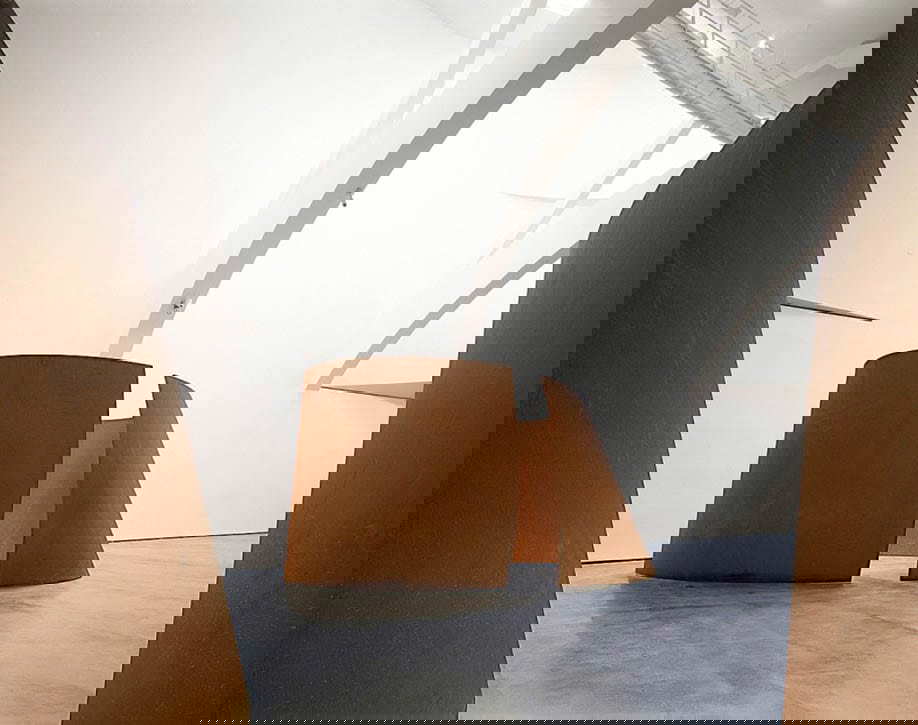
Richard Serra continued creating large-calibration Cor-X steel sculptures during the 1990s. In 1991, Storm Male monarch invited him to grace their holding with Schunnemunk Fork, four steel plates set among luscious rolling hills. Serra also took increasing impetus from Japanese Zen Gardens during this period, mesmerized by the concept of sculpture as an endless game of hide and seek, never to be comprehended upon outset glance. Similarly, his 1994 Ophidian decorated the Guggenheim Bilbao with serpentine pathways forged from steel, encouraging viewers to meander negative infinite. Between awe-inspiring arcs, boundless spirals, and round ellipses, Serra too reformed his structural prospects. His artistic vocabulary overflowed with curvilinear forms while he scoured his Italian memories, devising a new Torqued Ellipse (1996) series. Double Torqued Ellipse , his most popular, counteracts Roman church San Carlo alle Quattro Fontane's angular facade by enclosing viewers in a fluid, round container. Newfound repose cocooned Serra's groundbreaking sculptural oasis.

Building on momentum from his well-received ellipses, Serra'due south invigorated instincts shaped his practice during the 2000s. He began his decade with a spin-off serial Torqued Spirals, inaugurated through a rolled-steel elliptical sculpture dedicated to Joseph Pulitzer. Contrasting happy blueish skies with his medium's moody colour palette, Joe (2000) encapsulated an democratic realm inside the Pulitzer Art Foundation, exposed to the ebb and flow of everyday life. In 2005, Serra returned to his native San Francisco to install his very first public sculpture in the city, Ballast. That same year, Guggenheim Bilbao likewise commemorated The Matter Of Fourth dimension, a permanent exhibition showcasing Serra's seven ellipses. There, snaking passages invoked a lack of security in vulnerable audiences, betraying logic despite a seemingly stable construction. Since then, he's also actualized sculptures in Qatar, and celebrated rotating exhibitions at blue-chip galleries like Gagosian. His contemporary career endures today even at eighty years one-time.
What Is Richard Serra's Cultural Legacy?

Now, Richard Serra is widely regarded as one of America's greatest 20th-century sculptors. Artists and architects alike cite him as motivation for continually pushing public installation to the avant-garde forefront, ping-ponging its purpose from institutional to utilitarian. Still despite critical success, some feminist historians believe Serra's macho blowing to be a patriarchal image of Mail service-War America. Subsequent modernist trailblazers, like Judy Chicago, rejected these masculine ethics equally obsolete, repositioning sculpture to seem impressive withal its use of grand materials. Despite pushback from generations following, Serra'due south seminal showpieces remain difficult to ignore, a straight, palpable byproduct of his mighty creative presence. Viewers worldwide wander these meditative sanctuaries every day in hopes of understanding his circuitous genius again, recollecting our corporeality with refreshed insight each case. Richard Serra towers like a tantalizing attestation to art as a societal office, sublime yet never fully static, forever evoking the extraordinary.
schullertince1996.blogspot.com
Source: https://www.thecollector.com/richard-serra/
0 Response to "Why Does Richard Serra Make the Art He Do"
Post a Comment